Understanding How Search Engines Work in 2026
Search engine optimization begins with a clear understanding of how search engines work. While the basic principles of crawling, indexing, and ranking remain the foundation of search technology, the systems behind modern search engines work become significantly more advanced. Artificial intelligence, natural language processing, machine learning, and user behavior analysis now play central roles in determining which content deserves top visibility.
In 2026, SEO professionals no longer optimize solely for algorithms—they optimize for users while ensuring search engines can understand, trust, and recommend their content.
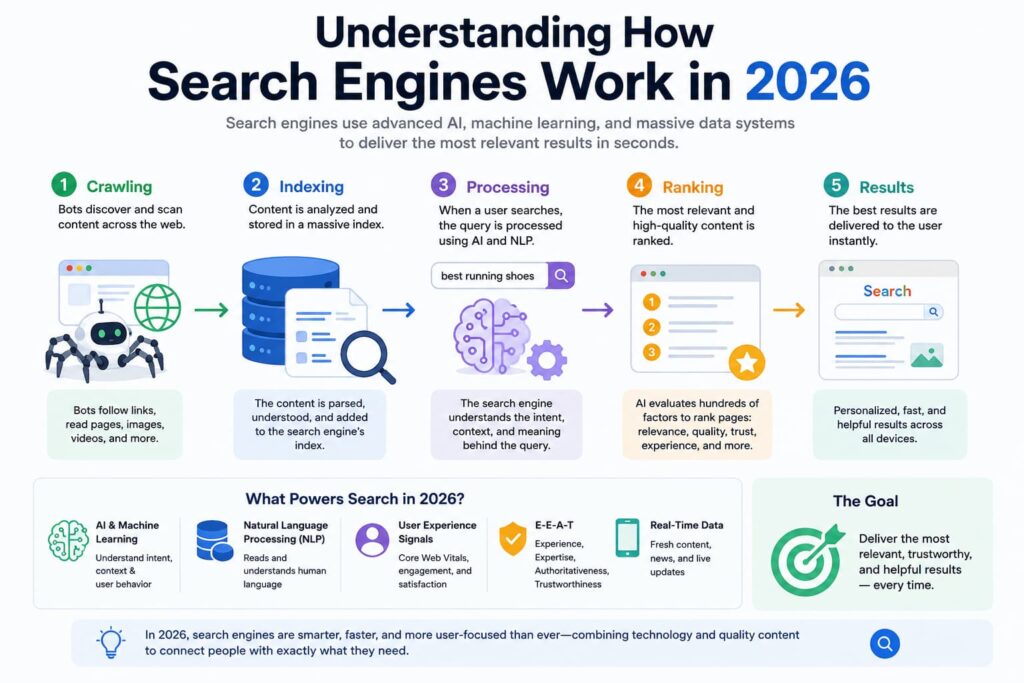
The Three Core Stages of How Search Engines Work
Every search engine follows three essential processes.
1. Crawling
Search engines use automated programs called crawlers or spiders to discover content across the internet.
These bots continuously visit:
- Websites
- Blogs
- News sites
- Online stores
- Forums
- Government websites
- Academic publications
They follow internal and external links to locate new or updated pages.
Good crawling depends on:
- Clear site architecture
- XML sitemaps
- Fast loading pages
- Internal linking
- Accessible navigation
Poor technical structure can prevent valuable pages from being discovered.
2. Indexing
After crawling a page, search engines analyze its contents.
During indexing they examine:
- Headlines
- Paragraphs
- Images
- Videos
- Metadata
- Internal links
- Structured data
- Page speed
- Mobile friendliness
The search engine determines what the page is about and stores this information in its index.
Think of the index as an enormous digital library where billions of web pages are categorized for future retrieval.
If a page cannot be indexed, it cannot appear in search results.
3. Ranking
When someone performs a search, the search engine instantly evaluates potentially millions of indexed pages.
It then determines which pages best satisfy the user’s query.
Ranking considers factors such as:
- Relevance
- Authority
- Trustworthiness
- User intent
- Content freshness
- Website performance
- Helpful information
- Historical quality signals
Machine learning continuously improves these rankings based on real-world user behavior.
Understanding Ho Search Engines work
Search intent has become one of the most important SEO concepts.
Modern search engines attempt to understand why someone performs a search rather than simply matching keywords.
The four major categories include:
Informational
Users want to learn.
Examples:
- What is SEO?
- How does Google rank websites?
- Beginner SEO guide
Content types:
- Blog posts
- Tutorials
- Guides
- Videos
Navigational
Users already know where they want to go.
Examples:
- YouTube
- Wikipedia
- Gmail login
Search engines prioritize official websites.
Commercial Investigation
Users are researching products or services before purchasing.
Examples:
- Best SEO tools
- Ahrefs vs Semrush
- Best laptops for students
These searches often lead to:
- Comparisons
- Reviews
- Buying guides
Transactional
Users are ready to take action.
Examples:
- Buy SEO course
- Download CRM software
- Hire SEO consultant
Landing pages optimized for conversions perform well here.
Semantic Search
Keywords still matter, but exact-match optimization is no longer enough.
Semantic search allows search engines to understand:
- Related concepts
- Synonyms
- Context
- User expectations
- Entity relationships
For example:
A page optimized for “digital marketing” should naturally discuss:
- SEO
- PPC
- Email marketing
- Content marketing
- Analytics
- Social media
Search engines recognize these relationships without requiring repetitive keyword usage.
Artificial Intelligence in Search
AI has transformed how search engines evaluate content.
Instead of relying solely on predefined ranking rules, machine learning models analyze patterns across billions of searches.
AI helps search engines understand:
- Writing quality
- Topic depth
- User satisfaction
- Content originality
- Expertise
- Readability
- Context
This means shallow articles filled with keywords are increasingly ineffective.
Entity-Based Search
Entities are people, places, organizations, products, events, and concepts that search engines can uniquely identify.
For example, when users search for “Apple,” search engines determine whether they mean:
- The technology company
- The fruit
- A music label
- Another context
By understanding entities and their relationships, search engines provide more accurate and relevant results.
Content that clearly defines entities, uses consistent terminology, and includes structured data is easier for search engines to interpret.
User Experience as a Ranking Signal
Search engines increasingly reward websites that provide excellent user experiences.
Important elements include:
- Fast page loading
- Mobile responsiveness
- Intuitive navigation
- Clear typography
- Accessible design
- Minimal intrusive ads
- Secure HTTPS connections
A technically sound website encourages visitors to stay longer and interact more, which can reinforce positive quality signals.
The Importance of Content Quality
High-quality content demonstrates:
- Accuracy
- Depth
- Originality
- Practical value
- Clear organization
Rather than publishing many short articles, successful websites often create comprehensive resources that thoroughly answer users’ questions.
Updating older content with current information is also important, especially in rapidly changing fields such as SEO and technology.
Technical Foundations
Technical SEO ensures search engines can efficiently access and understand your website.
Key areas include:
- Crawlability
- Indexability
- XML sitemaps
- Robots directives
- Canonical URLs
- Structured data
- Core Web Vitals
- HTTPS security
Ignoring technical issues can limit the visibility of even the best content.
Measuring Success
Modern SEO success extends beyond rankings.
Useful metrics include:
- Organic traffic
- Click-through rate (CTR)
- Conversion rate
- Average engagement time
- Returning visitors
- Indexed pages
- Keyword visibility
- Revenue from organic search
Focusing on business outcomes rather than rankings alone provides a clearer picture of SEO performance.
Key Takeaways
Search engines in 2026 are sophisticated systems designed to understand language, intent, and user satisfaction. Effective SEO requires more than inserting keywords—it demands valuable content, excellent technical implementation, and a user-first approach. By understanding how crawling, indexing, ranking, semantic search, AI, and user experience work together, you build a strong foundation for every SEO strategy discussed in the chapters ahead.
Chapter 3: Keyword Research in 2026 – Finding Opportunities That Drive Traffic and Conversions
Keyword research remains the cornerstone of every successful SEO strategy, but the way marketers approach it has changed dramatically. In the early days of search engine optimization, success often came from identifying high-volume keywords and repeating them throughout a webpage. Today, search engines are far more sophisticated. They understand context, user intent, semantic relationships, and topical relevance. As a result, effective keyword research in 2026 is no longer about finding a single “perfect keyword.” Instead, it is about understanding what your audience wants, how they search, and how your content can satisfy those needs better than competing pages.
Whether you are building a personal blog, an e-commerce website, a SaaS platform, or a corporate website, keyword research serves as the roadmap for your content strategy. Done correctly, it helps you create valuable content that attracts qualified visitors, increases engagement, and drives meaningful conversions.
Why Keyword Research Still Matters
Many people mistakenly believe that artificial intelligence has made keyword research obsolete. In reality, AI has made it more important than ever. Search engines use advanced algorithms to interpret meaning rather than simply matching words. However, users still express their needs through search queries, and understanding those queries provides valuable insight into customer behavior.
Keyword research helps you:
- Understand what your audience is searching for.
- Discover new content opportunities.
- Measure demand for products or services.
- Improve website architecture.
- Identify gaps in competitors’ content.
- Increase qualified organic traffic.
- Build topical authority within your niche.
Instead of focusing solely on rankings, keyword research now helps businesses align their content with customer needs throughout the buying journey.
Understanding How Search Engines Work
The first step in modern keyword research is understanding search intent. Search engines prioritize pages that best satisfy the reason behind a user’s query.
There are four primary categories of search intent.
Informational Intent
Users want information or answers.
Examples include:
- What is SEO?
- How does keyword research work?
- Benefits of content marketing
- Beginner’s guide to WordPress
These searches are best answered with educational content, tutorials, and comprehensive guides.
Navigational Intent
The user wants to visit a specific website.
Examples:
- YouTube
- Facebook Login
- Amazon
- Gmail
Ranking for navigational keywords is generally only practical if you own or represent the brand.
Commercial Investigation
Users are comparing products before making a purchase.
Examples include:
- Best SEO software
- Ahrefs vs Semrush
- Best website builder
- Top AI writing tools
These searches are ideal for comparison articles, reviews, and buying guides.
Transactional Intent
Users are ready to act.
Examples include:
- Buy running shoes online
- Hire SEO consultant
- Purchase CRM software
- Download project management app
Landing pages, product pages, and service pages should target these keywords.
The Evolution of Keywords
Keyword optimization has progressed through several stages.
First Generation
- Exact-match keywords
- Keyword stuffing
- High density optimization
Second Generation
- Long-tail keywords
- Semantic variations
- User-friendly writing
Third Generation (2026)
- Topic clusters
- Entity optimization
- Intent-focused content
- Natural language
- Conversational search
- AI-friendly formatting
Modern SEO emphasizes comprehensive topic coverage rather than repeating exact phrases.
Engines
Long-Tail Keywords
Examples:
- Best SEO strategy for small businesses
- How to optimize Shopify product pages
- Affordable SEO tools for beginners
Advantages:
- Lower competition
- Higher conversion rates
- Clear user intent
- Easier rankings
Successful websites typically target hundreds or thousands of long-tail keywords rather than relying on a few broad terms.
Long-Tail Keywords
Examples:
- Best SEO strategy for small businesses
- How to optimize Shopify product pages
- Affordable SEO tools for beginners
Advantages:
- Lower competition
- Higher conversion rates
- Clear user intent
- Easier rankings
Successful websites typically target hundreds or thousands of long-tail keywords rather than relying on a few broad terms.
Understanding Keyword Metrics
When evaluating keywords, several metrics should be considered.
Search Volume
Indicates how often users search for a particular phrase.
Higher volume does not always mean better opportunities because competition may also be higher.
Keyword Difficulty
Estimates how challenging it will be to rank.
Factors include:
- Competition
- Domain authority
- Existing backlinks
- Content quality
Beginners often benefit from focusing on low-to-medium difficulty keywords.
How Search Engine Work
A keyword should align with the purpose of your content.
A product page should not target informational keywords if users expect educational articles.
Conversion Potential
Some keywords generate traffic.
Others generate revenue.
For example:
“What is SEO?”
may attract many visitors.
“Hire SEO consultant”
may generate fewer visitors but far more business opportunities.
Finding Keyword Ideas
There are numerous methods for discovering valuable keywords.
How Search Engines Work Suggestions
Autocomplete suggestions reveal common user searches.
Similarly, “People Also Ask” sections provide valuable insights into related questions.
Competitor Analysis
Study competing websites to identify:
- Ranking keywords
- Content gaps
- Popular topics
- Frequently updated pages
Competitor research often uncovers opportunities you may have overlooked.
Customer Questions
Customer support emails, sales calls, forums, and social media discussions reveal real problems your audience wants solved.
These authentic questions often make excellent article topics.
Community Platforms
Communities such as Reddit, Quora, industry forums, and professional discussion groups provide a wealth of keyword inspiration because they reflect genuine user language.
Internal Website Search
If your website includes a search feature, reviewing search logs can reveal exactly what visitors are trying to find.
These insights can guide new content creation and improve existing pages.
Organizing Keywords
Successful SEO campaigns organize keywords into categories.
Example:
Primary Keyword:
SEO Checklist
Supporting Keywords:
- Technical SEO checklist
- On-page SEO checklist
- SEO audit checklist
- Website optimization checklist
- Search engine optimization checklist
Related Questions:
- What should an SEO checklist include?
- How often should I perform an SEO audit?
- What tools help with SEO?
This organization helps create comprehensive content that addresses multiple user needs.
Keyword Cannibalization
One common mistake is targeting the same keyword with multiple pages.
Example:
- Beginner SEO Guide
- SEO for Beginners
- Learn SEO Basics
- SEO Starter Guide
If all pages target identical search intent, they may compete against one another, weakening overall performance.
Instead, consolidate similar topics into stronger, more comprehensive resources whenever appropriate.
Voice Search Keywords
Voice assistants have changed how people search.
Typed query:
SEO tools
Voice query:
“What are the best SEO tools for small businesses in 2026?”
Voice searches tend to be:
- Longer
- More conversational
- Question-based
- Context-rich
Creating FAQ sections and using natural language helps capture voice search traffic.
Local Keyword Research
Businesses serving specific geographic areas should incorporate location-based keywords.
Examples include:
- SEO agency in London
- Best dentist in Chicago
- Coffee shop near Central Park
- Wedding photographer in Sydney
Optimizing for local intent requires combining service keywords with geographic relevance while maintaining natural readability.
Seasonal Keywords
Search demand fluctuates throughout the year.
Examples include:
- Black Friday deals
- Christmas gifts
- Summer travel destinations
- Tax filing software
Publishing seasonal content well in advance gives search engines time to crawl, index, and rank the pages before demand peaks.
AI and Predictive Keyword Research
Modern AI-powered SEO platforms can identify emerging trends before they become highly competitive.
Predictive keyword research analyzes:
- Industry news
- Search trends
- Consumer behavior
- Historical seasonality
- Social media discussions
This allows businesses to create content ahead of competitors, capturing early search demand.
Common Keyword Research Mistakes
Avoid these frequent errors:
- Targeting only high-volume keywords.
- Ignoring search intent.
- Choosing keywords unrelated to business goals.
- Overusing exact-match phrases.
- Creating duplicate content around similar topics.
- Neglecting long-tail opportunities.
- Failing to update keyword strategies regularly.
- Ignoring user questions and conversational searches.
Effective keyword research is an ongoing process rather than a one-time task.
Creating a Keyword Strategy
A strong keyword strategy typically includes:
- Define business goals.
- Identify target audiences.
- Research primary topics.
- Discover related long-tail keywords.
- Group keywords into topic clusters.
- Prioritize opportunities based on difficulty and value.
- Create content that fully satisfies user intent.
- Monitor performance and refine the strategy over time.
This structured approach ensures that every piece of content supports broader SEO objectives.
Key Takeaways
Keyword research in 2026 is about understanding people, not just search terms. Successful SEO professionals focus on user intent, topical authority, semantic relevance, and comprehensive content rather than isolated keywords. By combining traditional keyword metrics with AI-driven insights, competitor analysis, and audience research, you can build a sustainable SEO strategy that attracts qualified traffic and supports long-term business growth.
Chapter 4: On-Page SEO Mastery – Optimizing Content for Users and how Search Engines Work
On-page SEO is the practice of optimizing individual web pages so they rank higher in search engine results and provide a better experience for users. While technical SEO focuses on website infrastructure and off-page SEO emphasizes authority through backlinks and brand recognition, on-page SEO ensures that every page communicates its purpose clearly to both visitors and search engines.
In 2026, on-page SEO is no longer about inserting keywords into every heading or paragraph. Search engines now use advanced artificial intelligence and natural language processing to understand context, relationships between topics, and the overall value of a page. The most successful websites are those that combine technical accuracy, engaging writing, excellent user experience, and strategic optimization.
This chapter explores every major element of modern on-page SEO and explains how to optimize content that ranks well while genuinely helping your audience.
What Is On-Page SEO?
On-page SEO includes every optimization made directly on a webpage. These elements help search engines understand what the page is about and determine whether it is relevant to a user’s search.
Important on-page SEO elements include:
- Title tags
- Meta descriptions
- Headings
- URL structure
- Content quality
- Keyword placement
- Internal links
- Image optimization
- Structured data
- User experience
- Mobile optimization
- Content freshness
Each of these elements contributes to better rankings, improved click-through rates, and higher user engagement.
Creating High-Quality Content
Content remains the most important component of on-page SEO. Search engines aim to deliver pages that answer users’ questions accurately, completely, and clearly.
High-quality content should be:
- Original
- Accurate
- Well researched
- Easy to read
- Helpful
- Comprehensive
- Regularly updated
Rather than writing for algorithms, focus on solving real problems. When your content provides practical value, it is more likely to earn backlinks, social shares, and positive engagement signals.
Writing Effective Title Tags and How Search Engines Work
The title tag is one of the first elements users see in search results. It also helps search engines understand the page’s primary topic.
A strong title tag should:
- Include the primary keyword naturally
- Be clear and descriptive
- Encourage clicks
- Stay within approximately 50–60 characters
- Reflect the page’s content accurately
Example:
SEO Checklist for Beginners: 25 Steps to Improve Rankings
This title is concise, informative, and encourages users to learn more.
Crafting Compelling Meta Descriptions
Although meta descriptions are not a direct ranking factor, they strongly influence click-through rates.
A good meta description should:
- Summarize the page clearly
- Include relevant keywords naturally
- Encourage action
- Stay between 140 and 160 characters
- Match the user’s search intent How Search Engines Work in 2026
For example:
Learn how to optimize your website with this complete SEO checklist. Improve rankings, increase traffic, and enhance user experience.
A persuasive description can increase traffic even if your ranking position remains unchanged.
Optimizing URL Structure
URLs should be short, descriptive, and easy to understand.
Good example:
example.com/on-page-seo-guide
Poor example:
example.com/page?id=12345&category=seo
Best practices include:
- Use lowercase letters.
- Separate words with hyphens.
- Avoid unnecessary numbers or symbols.
- Keep URLs concise.
- Include the primary keyword where appropriate. How Search Engines Work in 2026
Clean URLs improve both user experience and crawlability.
Using Headings Effectively
Headings organize content into logical sections, making it easier for readers and search engines to understand the page.
A typical structure includes:
- H1 for the main title
- H2 for major sections
- H3 for subsections
- H4 when additional hierarchy is needed
Avoid using headings solely for styling purposes. Instead, use them to create a clear outline of your content.
Optimizing Content for Readability
Even excellent information can fail if it is difficult to read.
Improve readability by:
- Writing short paragraphs
- Using bullet points
- Including numbered lists
- Breaking up long sections with headings
- Using simple language where possible
- Avoiding unnecessary jargon How Search Engines Work in 2026
- Highlighting important ideas
Readable content keeps users engaged and reduces bounce rates.
Strategic Keyword Placement
Keywords still play an important role, but natural usage is essential.
Include your primary keyword in:
- Title tag
- H1 heading
- Introduction
- One or two subheadings
- URL
- Meta description How Search Engines Work in 2026
- Image alt text (when relevant)
- Conclusion
Use related phrases and synonyms throughout the article to help search engines understand the broader topic. Avoid forcing keywords into sentences where they do not fit naturally
Semantic SEO How Search Engines Work
Semantic SEO focuses on covering an entire topic rather than repeating a single keyword.
For example, an article about “On-Page SEO” should naturally mention related concepts such as:
- Meta tags
- Content optimization
- Internal links
- Search intent
- Structured data
- Page speed
- User experience
- Mobile responsiveness
This comprehensive approach demonstrates topical expertise and aligns with how modern search engines interpret content.
Internal Linking
Internal links connect pages within your own website.
Benefits include:
- Helping search engines discover content
- Distributing page authority
- Improving navigation
- Increasing time spent on the site
- Encouraging users to explore related topics
Use descriptive anchor text that accurately reflects the destination page.
For example:
Learn more in our complete technical SEO guide.
Avoid generic anchor text such as “Click here.”
How Search Engines Work
External Linking
Linking to trustworthy external sources can improve the credibility of your content. How Search Engines Work in 2026
Choose reputable websites such as:
- Government organizations
- Educational institutions
- Industry leaders
- Academic research
- Official documentation
- How Search Engines Work
External links should enhance the reader’s understanding rather than distract from your content. How Search Engines Work in 2026
Optimizing Images
Images improve user engagement and make content easier to understand.
Best practices include:
- Use descriptive filenames.
- Compress images for faster loading.
- Add meaningful alt text.
- Choose high-quality visuals.
- Use responsive image sizes.
- Include captions when appropriate.
- How Search Engines Work
Alt text improves accessibility while helping search engines understand image content. How Search Engines Work in 2026
Multimedia Content
Modern search engines recognize the value of diverse content formats.
Consider including: How Search Engines Work
- Videos
- Infographics
- Charts
- Interactive tools
- Tables
- Screenshots
Multimedia enhances engagement and often increases the amount of time users spend on a page. How Search Engines Work
User Experience Signals
Although search engines do not reveal every ranking signal, positive user experiences often correlate with better performance.
Focus on:
- Fast loading pages
- Easy navigation
- Clean design
- Readable typography
- Logical content flow
- Mobile responsiveness
- Accessible interfaces How Search Engines Work
A satisfied visitor is more likely to remain on the page, explore additional content, and return in the future.
Mobile Optimization
With the majority of searches occurring on mobile devices, every page should perform well on smaller screens. How Search Engines Work
Ensure that your website:
- Uses responsive design
- Loads quickly How Search Engines Work
- Features touch-friendly navigation
- Displays readable text without zooming
- Avoids intrusive pop-ups
A seamless mobile experience supports both rankings and user satisfaction. How Search Engines Work
Structured Data and How Search Engines Work
Structured data provides search engines with additional information about your content.
Common schema types include: How Search Engines Work
- Article
- FAQ
- Product
- Organization
- Local Business
- Recipe
- Review
- Event
- How Search Engines Work
Proper implementation can improve how your pages appear in search results by enabling rich snippets and enhanced listings.
Content Freshness of How Search Engines Work
Search engines often prefer content that remains current and relevant.
Update older articles by:
- Adding new information
- Revising outdated statistics
- Improving readability
- Expanding sections
- Replacing broken links
- Updating screenshots
- How Search Engines Work
Regular updates signal that your website remains active and trustworthy.
Featured Snippet Optimization
Featured snippets appear above traditional search results for many informational queries. How Search Engines Work
To improve your chances of earning one:
- Answer questions directly.
- Use numbered lists.
- Include bullet points.
- Write concise definitions.
- Organize content with clear headings.
- Add tables where appropriate.
Providing immediate, well-structured answers increases visibility.
Avoiding Common On-Page SEO Mistakes and How Search Engines Work
Some of the most common mistakes include:
- Keyword stuffing
- Duplicate content
- Thin articles with little value
- Missing title tags
- Poor heading structure
- Slow-loading pages
- Broken internal links
- Ignoring mobile usability
- Overusing advertisements
- Publishing outdated information
- How Search Engines Work
Avoiding these issues improves both search visibility and user trust. How Search Engines Work
On-Page SEO Checklist
Before publishing a page, review the following checklist:
- Primary keyword included naturally
- Clear and engaging title tag
- Optimized meta description
- Logical heading hierarchy
- Comprehensive, original content
- Internal and external links added
- Images compressed with descriptive alt text
- Mobile-friendly layout
- Fast loading speed
- Structured data implemented where applicable
- Content proofread for grammar and readability
- Updated information and accurate facts
- How Search Engines Work
Following this checklist consistently can significantly improve the quality and performance of your content. How Search Engines Work
Measuring On-Page SEO Performance
Track the effectiveness of your optimizations How Search Engines Workusing metrics such as:
- Organic traffic
- Click-through rate (CTR)
- Average engagement time
- Bounce rate
- Conversion rate
- Average ranking position
- Indexed pages
- Core Web Vitals
- Internal link performance
Regular analysis helps identify opportunities for further improvement.
Key Takeaways How Search Engines Work
On-page SEO in 2026 is about creating pages that are valuable, accessible, and easy for both users and search engines to understand. By combining high-quality content, strategic keyword usage, logical structure, optimized multimedia, and exceptional user experience, you create web pages that can compete effectively in increasingly sophisticated search environments. Rather than optimizing for algorithms alone, How Search Engines Work focus on delivering the best possible answer to your audience’s needs. When users benefit, search engines are far more likely to reward your content with greater visibility.
Chapter 5: Technical SEO in 2026 – Building a Strong Foundation for Search Success and How Search Engines Work
Technical SEO is the backbone of every successful website. No matter how informative your content is or how many backlinks you earn, your pages cannot achieve their full ranking potential if search engines struggle to crawl, index, How Search Engines Work or understand your website. In 2026, technical SEO has evolved beyond fixing broken links and creating XML sitemaps. It now focuses on delivering fast, secure, accessible, and AI-friendly websites that provide exceptional user experiences across every device. How Search Engines Work
Modern search engines use advanced algorithms to evaluate not only the quality of your content but also the technical health of your website. Factors such as page speed, mobile usability, structured data, Core Web Vitals, crawl efficiency, and website security all contribute to search visibility. This chapter explains the essential components of technical SEO and provides practical guidance for building a website that both users and search engines can trust. How Search Engines Work
What Is Technical SEO?
Technical SEO refers to optimizing the infrastructure of your website so search engines can efficiently discover, crawl, index, and rank your content. Unlike on-page SEO, which focuses on individual pages, technical SEO addresses the performance and architecture of the entire website. How Search Engines Work
The primary goals of technical SEO are to:
- Improve crawlability.
- Ensure pages are indexed correctly.
- Increase website speed.
- Enhance user experience.
- Maintain website security.
- Prevent duplicate content issues.
- Support structured data implementation.
- Improve overall search engine visibility.
Without a solid technical foundation, even the highest-quality content may struggle to achieve strong rankings. How Search Engines Work

Leave a Reply