

How AI Is Changing SEO in 2026 Artificial Intelligence (AI) has transformed the digital ma digital marketing landscaperketing landscape, and in 2026, it is reshaping SEO more than ever before. Search engines have become smarter, user expectations have increased, and businesses must adapt to remain competitive. Traditional SEO techniques like keyword stuffing and mass link building are no longer enough. Success now depends on creating valuable, user-focused content enhanced by AI-powered insights.
Whether you’re a blogger, business owner, or digital marketer, understanding how AI is changing SEO in 2026 will help you improve rankings, attract qualified traffic, and build long-term online authority.
The Evolution of AI in Search Engines
Search engines have evolved from matching keywords to understanding user intent. AI algorithms now analyze context, behavior, and content quality instead of relying solely on exact keyword matches.
Modern AI systems can:
- Understand natural language and conversational queries.
- Analyze search intent more accurately.
- Recognize high-quality, trustworthy content.
- Detect spam and low-value pages.
- Deliver highly personalized search results.
This means websites must focus on solving user problems rather than simply targeting keywords.
AI-Powered Search Intent Analysis
One of the biggest changes in SEO is AI’s ability to understand why users are searching.
Instead of asking:
“What keywords should I rank for?”
Businesses now ask:
“What problem is my audience trying to solve?”
AI categorizes searches into several intent types:
- Informational searches
- Navigational searches
- Commercial investigation
- Transactional searches
- How AI Is Changing SEO
Creating content that directly satisfies these intents significantly improves rankings and user engagement.
Smarter Keyword Research
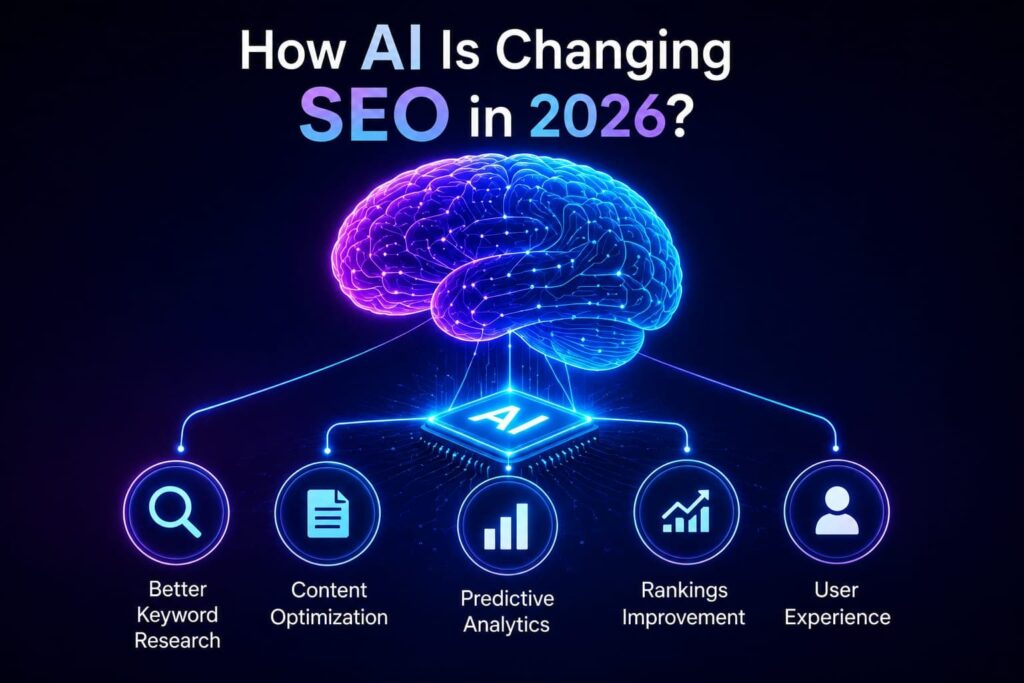
Keyword research in 2026 is no longer about finding high-volume phrases alone. AI tools analyze search behavior, user interests, seasonal trends, and semantic relationships between topics.
Modern AI helps marketers discover:
- Long-tail keywords
- Question-based searches
- Emerging search trends
- Topic clusters
- Semantic keywords
- Voice search phrases
- How AI Is Changing SEO
Instead of targeting one keyword per page, websites now build comprehensive topical authority around entire subjects.
AI Helps Create Better Content
Content remains the foundation of SEO, but AI has changed how it is planned, written, and optimized.
AI assists content creators by:
- Generating topic ideas
- How AI Is Changing SEO
- Building article outlines
- How AI Is Changing SEO
- Suggesting related keywords
- Improving readability
- Detecting content gaps
- Optimizing headlines
- Recommending internal links
However, human expertise remains essential. Search engines reward original insights, real-world experience, and trustworthy information rather than generic AI-generated text.
The best-performing content combines AI efficiency with human creativity.
EEAT Matters More Than Ever
Google continues to prioritize Experience, Expertise, Authoritativeness, and Trustworthiness (EEAT) in 2026.
AI evaluates signals such as:
- Author credibility
- Content accuracy
- Reliable references
- Website reputation
- User engagement
- Helpful content
- How AI Is Changing SEO
Businesses that demonstrate real expertise consistently outperform websites publishing thin or low-quality content.
Voice Search Continues to Grow
AI assistants have become increasingly popular, making voice search an important part of SEO.
Users now search using conversational questions like:
- “What’s the best SEO strategy for a small business?”
- “How can I improve my website ranking?”
- “Which AI tool is best for keyword research?”
Optimizing for voice search involves:
- Writing naturally.
- Answering questions directly.
- Using FAQ sections.
- Creating concise answers.
- Optimizing for featured snippets.
- How AI Is Changing SEO
AI Improves Technical SEO
Technical SEO has become easier with AI-powered automation.
AI tools can quickly identify:How AI Is Changing SEO
- Broken links
- Duplicate content
- Slow-loading pages
- Missing metadata
- Mobile usability issues
- Crawl errors
- Structured data opportunities
- How AI Is Changing SEO
Instead of spending hours auditing websites manually, SEO professionals can focus on implementing improvements that enhance user experience.
Predictive SEO Is Becoming the New Standard
AI can now forecast future search trends before they become competitive.
Predictive SEO helps marketers:
- Identify rising keywords
- Publish content before competitors
- Anticipate seasonal demand
- Monitor changing user behavior
- Discover emerging industry topics
- How AI Is Changing SEO
This proactive approach gives businesses a significant competitive advantage.
Personalized Search Results
AI increasingly customizes search results based on factors such as:
- Search history
- Device type
- User location
- Interests
- How AI Is Changing SEO
- Previous interactions
As a result, ranking positions may vary between users. Businesses should focus less on a single ranking number and more on overall visibility, engagement, and conversions.
Visual Search Is Expanding
AI-powered image recognition has made visual search more accurate than ever.
Optimizing images now includes:
- Descriptive filenames
- How AI Is Changing SEO
- Keyword-rich alt text
- High-quality visuals
- Fast image loading
- Proper image schema
Businesses using original, optimized visuals can gain additional search visibility through image search results.
AI and Content Personalization
Modern websites use AI to deliver personalized experiences for visitors.
Examples include:
- Customized product recommendations
- Personalized blog suggestions
- Dynamic landing pages
- Tailored email campaigns
- Intelligent chatbots
- How AI Is Changing SEO
These improvements increase user engagement, reduce bounce rates, and strengthen SEO performance.
The Growing Importance of Topical Authority
Rather than publishing isolated articles, successful websites now create comprehensive content ecosystems.
For example, instead of writing a single article about SEO, businesses build clusters covering:
- Keyword research
- How AI Is Changing SEO
- On-page SEO
- Technical SEO
- Link building
- Local SEO
- AI SEO strategies
- Content marketing
- Website optimization
This approach demonstrates expertise and improves rankings across related search queries.
AI Doesn’t Replace Human Creativity
Although AI has become an essential SEO assistant, it cannot replace authentic human experience.
Successful content still requires:
- Original opinions
- How AI Is Changing SEO
- Personal case studies
- Industry expertise
- Emotional storytelling
- Creative problem-solving
- Trustworthy recommendations
Search engines increasingly reward content that reflects genuine experience rather than automated content production.
Best Practices for AI-Powered SEO in 2026
To stay ahead in 2026, follow these proven strategies:How AI Is Changing SEO
- Create people-first content that answers real questions.
- Build topical authority with comprehensive content clusters.
- Use AI for research and optimization, not complete content creation.
- Optimize for voice and conversational searches.
- Improve page speed and Core Web Vitals.
- Add structured data where appropriate.
- Strengthen EEAT through expert, trustworthy content.
- Regularly update existing articles with fresh information.
- Monitor user behavior and engagement metrics.
- Combine AI insights with human expertise.
- How AI Is Changing SEO
Final Thoughts
Artificial Intelligence is transforming SEO in remarkable ways, making search engines more intelligent and user-focused than ever before. Businesses that embrace AI while maintaining originality, expertise, and trust will be best positioned to succeed in 2026.
The future of SEO is not about replacing humans with AI—it is about using AI as a powerful assistant to create better content, improve user experiences, and make smarter optimization decisions. By adapting to these changes today, you can build a stronger online presence and achieve sustainable search rankings for years to come.
If you’d like, I can also create a featured image prompt, SEO title, meta description, FAQs, schema markup, and a 2,500+ word version of this article.How AI Is Changing SEO
Certainly! Here’s the continuation of your article.
Common AI SEO Mistakes to Avoid
While AI offers incredible advantages, relying on it without human oversight can hurt your SEO performance. Search engines have become highly effective at identifying low-quality, repetitive, or purely machine-generated content that lacks originality and value.How AI Is Changing SEO
Avoid these common mistakes:
Publishing AI Content Without Editing
AI-generated drafts should always be reviewed, fact-checked, and enhanced with unique insights. Adding personal experience, industry expertise, and real examples helps create content that stands out from competitors.
Ignoring User Experience
Even the best-written content won’t rank well if users struggle to navigate your website. AI can help optimize content, but factors like page speed, mobile responsiveness, intuitive navigation, and accessibility remain essential.
Overusing Keywords
AI tools may recommend relevant keywords, but forcing them into every paragraph creates unnatural content. Instead, use keywords strategically while maintaining a smooth reading experience.How AI Is Changing SEO
Forgetting to Update Existing Content
SEO is an ongoing process. AI can identify outdated information and recommend improvements, but website owners should regularly refresh articles with current statistics, new examples, and updated best practices.
AI Tools That Help Improve SEO
A growing number of AI-powered platforms simplify SEO tasks, making optimization faster and more efficient. These tools can assist with everything from keyword research to technical audits.How AI Is Changing SEO
Popular AI SEO applications include:
- Content optimization and readability analysis
- Keyword discovery and topic clustering
- Competitor analysis
- Internal linking suggestions
- Technical SEO audits
- Content gap analysis
- How AI Is Changing SEO
- Search trend forecasting
- Performance reporting
The most successful SEO professionals use AI as a productivity tool while relying on their own expertise to make strategic decisions.How AI Is Changing SEO
Measuring SEO Success in the AI Era
As AI changes search behavior, marketers must track more than just keyword rankings. Modern SEO success is measured by a combination of visibility, engagement, and business outcomes.
Important metrics include:
- Organic traffic growth
- Click-through rate (CTR)
- Average engagement time
- Bounce rate
- Conversion rate
- Returning visitors
- How AI Is Changing SEO
- Indexed pages
- Core Web Vitals performance
- Featured snippet visibility
- AI Overview and rich result appearances
Monitoring these metrics provides a more complete picture of your website’s overall performance.
Preparing Your Website for the Future of AI SEO
Search technology will continue to evolve, making adaptability one of the most valuable SEO skills. Businesses that invest in high-quality content, technical excellence, and user satisfaction will remain competitive regardless of algorithm changes.How AI Is Changing SEO
To future-proof your website:
- Publish original, research-backed content.
- How AI Is Changing SEO
- Demonstrate real expertise and first-hand experience.
- Optimize for mobile devices and fast loading speeds.
- Build clear content clusters around your core topics.
- Use structured data to help search engines understand your pages.
- Improve accessibility for all users.
- Earn authoritative backlinks naturally through valuable content.
- Regularly monitor performance and update older articles.
A consistent focus on quality ensures your content remains relevant as AI-powered search continues to advance.
Frequently Asked Questions (FAQs)
Will AI Replace SEO?
No. AI is transforming SEO, not replacing it. It automates repetitive tasks and provides valuable insights, but human creativity, strategy, and expertise remain essential for long-term success.How AI Is Changing SEO
Can AI Write SEO-Friendly Content?
Yes, AI can generate optimized drafts and suggest improvements. However, the best results come from combining AI-generated content with human editing, fact-checking, and unique perspectives.
Is Keyword Research Still Important in 2026?
Absolutely. Keyword research has evolved beyond search volume to include search intent, semantic relevance, and topic authority. AI helps uncover these opportunities more effectively than traditional methods.How AI Is Changing SEO
How Does AI Affect Google Rankings?
AI helps search engines better understand content quality, user intent, and website authority. Pages that provide helpful, trustworthy, and user-focused information are more likely to achieve higher rankings.How AI Is Changing SEO
What Is the Biggest AI SEO Trend in 2026?
The biggest trend is the shift toward intent-based search, topical authority, personalized search experiences, and AI-assisted content optimization. Websites that focus on solving user problems rather than chasing keywords will have the greatest advantage.How AI Is Changing SEO
Conclusion
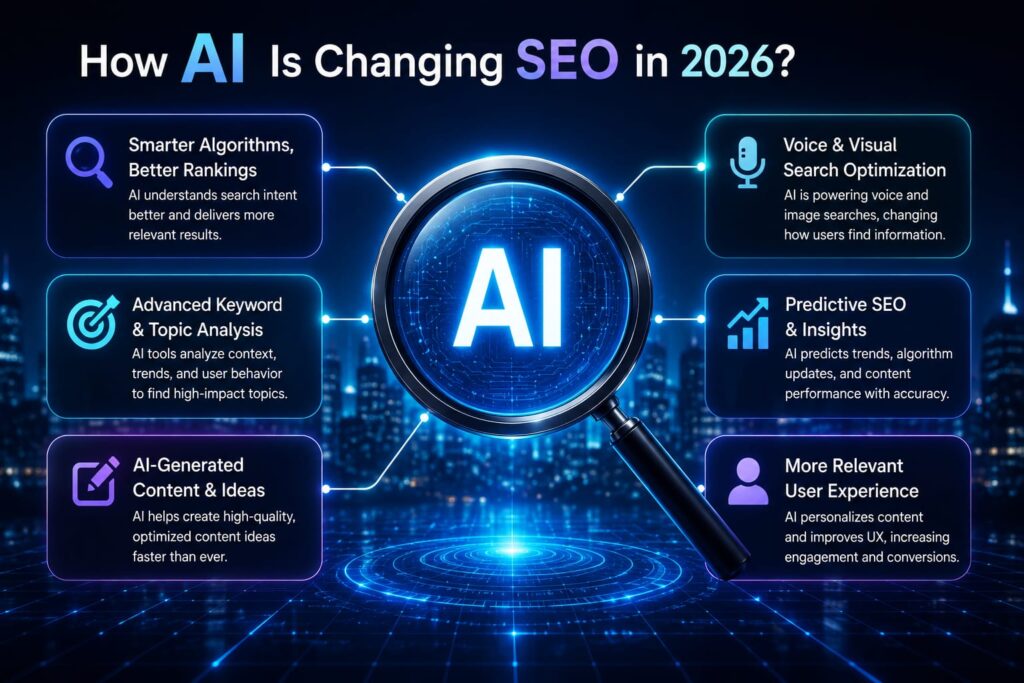
Artificial Intelligence is redefining the future of search engine optimization in 2026. From advanced keyword research and predictive analytics to personalized search results and automated technical audits, AI empowers businesses to make smarter SEO decisions. Yet technology alone is not enough.
The most successful websites combine AI’s efficiency with authentic human expertise, original insights, and a commitment to delivering exceptional user experiences. As search engines continue to evolve, businesses that prioritize quality, trust, and continuous improvement will earn stronger rankings, attract loyal audiences, and achieve sustainable organic growth.
AI is no longer just a helpful addition to SEO—it has become an essential partner in building a successful digital presence for the years ahead.How AI Is Changing SEO
If you’re building a long-form SEO guide, the next logical section would be “Top AI SEO Tools to Use in 2026” or “The Future of AI and Search Beyond 2026.”
Here is an SEO-friendly article on How AI Is Changing SEO in 2026.
How AI Is Changing SEO in 2026
Artificial Intelligence (AI) has transformed the digital marketing landscape, and in 2026, it is reshaping SEO more than ever before. Search engines have become smarter, user expectations have increased, and businesses must adapt to remain competitive. Traditional SEO techniques like keyword stuffing and mass link building are no longer enough. Success now depends on creating valuable, user-focused content enhanced by AI-powered insights.
Whether you’re a blogger, business owner, or digital marketer, understanding how AI is changing SEO in 2026 will help you improve rankings, attract qualified traffic, and build long-term online authority.How AI Is Changing SEO
The Evolution of AI in Search Engines
Search engines have evolved from matching keywords to understanding user intent. AI algorithms now analyze context, behavior, and content quality instead of relying solely on exact keyword matches.
Modern AI systems can:
- Understand natural language and conversational queries.
- Analyze search intent more accurately.
- Recognize high-quality, trustworthy content.
- Detect spam and low-value pages.
- Deliver highly personalized search results.
This means websites must focus on solving user problems rather than simply targeting keywords.
AI-Powered Search Intent Analysis
One of the biggest changes in SEO is AI’s ability to understand why users are searching.
Instead of asking:
“What keywords should I rank for?”
Businesses now ask:
“What problem is my audience trying to solve?”
AI categorizes searches into several intent types:
- Informational searches
- Navigational searches
- Commercial investigation
- Transactional searches
Creating content that directly satisfies these intents significantly improves rankings and user engagement.
Smarter Keyword Research
Keyword research in 2026 is no longer about finding high-volume phrases alone. AI tools analyze search behavior, user interests, seasonal trends, and semantic relationships between topics.
Modern AI helps marketers discover:
- Long-tail keywords
- Question-based searches
- Emerging search trends
- Topic clusters
- Semantic keywords
- Voice search phrases
Instead of targeting one keyword per page, websites now build comprehensive topical authority around entire subjects.
AI Helps Create Better Content
Content remains the foundation of SEO, but AI has changed how it is planned, written, and optimized.
AI assists content creators by:
- Generating topic ideas
- Building article outlines
- Suggesting related keywords
- Improving readability
- Detecting content gaps
- Optimizing headlines
- Recommending internal links
However, human expertise remains essential. Search engines reward original insights, real-world experience, and trustworthy information rather than generic AI-generated text.
The best-performing content combines AI efficiency with human creativity.
EEAT Matters More Than Ever
Google continues to prioritize Experience, Expertise, Authoritativeness, and Trustworthiness (EEAT) in 2026.
AI evaluates signals such as:
- Author credibility
- Content accuracy
- Reliable references
- Website reputation
- User engagement
- Helpful content
Businesses that demonstrate real expertise consistently outperform websites publishing thin or low-quality content.
Voice Search Continues to Grow
AI assistants have become increasingly popular, making voice search an important part of SEO.
Users now search using conversational questions like:
- “What’s the best SEO strategy for a small business?”
- “How can I improve my website ranking?”
- “Which AI tool is best for keyword research?”
Optimizing for voice search involves:
- Writing naturally.
- Answering questions directly.
- Using FAQ sections.
- Creating concise answers.
- Optimizing for featured snippets.
AI Improves Technical SEO
Technical SEO has become easier with AI-powered automation.
AI tools can quickly identify:
- Broken links
- Duplicate content
- Slow-loading pages
- Missing metadata
- Mobile usability issues
- Crawl errors
- Structured data opportunities
Instead of spending hours auditing websites manually, SEO professionals can focus on implementing improvements that enhance user experience.
Predictive SEO Is Becoming the New Standard
AI can now forecast future search trends before they become competitive.
Predictive SEO helps marketers:
- Identify rising keywords
- Publish content before competitors
- Anticipate seasonal demand
- Monitor changing user behavior
- Discover emerging industry topics
This proactive approach gives businesses a significant competitive advantage.
Personalized Search Results
AI increasingly customizes search results based on factors such as:
- Search history
- Device type
- User location
- Interests
- Previous interactions
As a result, ranking positions may vary between users. Businesses should focus less on a single ranking number and more on overall visibility, engagement, and conversions.
Visual Search Is Expanding
AI-powered image recognition has made visual search more accurate than ever.
Optimizing images now includes:
- Descriptive filenames
- Keyword-rich alt text
- High-quality visuals
- Fast image loading
- Proper image schema
Businesses using original, optimized visuals can gain additional search visibility through image search results.
AI and Content Personalization
Modern websites use AI to deliver personalized experiences for visitors.
Examples include:
- Customized product recommendations
- Personalized blog suggestions
- Dynamic landing pages
- Tailored email campaigns
- Intelligent chatbots
These improvements increase user engagement, reduce bounce rates, and strengthen SEO performance.
The Growing Importance of Topical Authority
Rather than publishing isolated articles, successful websites now create comprehensive content ecosystems.
For example, instead of writing a single article about SEO, businesses build clusters covering:
- Keyword research
- On-page SEO
- Technical SEO
- Link building
- Local SEO
- AI SEO strategies
- Content marketing
- Website optimization
This approach demonstrates expertise and improves rankings across related search queries.
AI Doesn’t Replace Human Creativity
Although AI has become an essential SEO assistant, it cannot replace authentic human experience.
Successful content still requires:
- Original opinions
- Personal case studies
- Industry expertise
- Emotional storytelling
- Creative problem-solving
- Trustworthy recommendations
Search engines increasingly reward content that reflects genuine experience rather than automated content production.
Best Practices for AI-Powered SEO in 2026
To stay ahead in 2026, follow these proven strategies:
- Create people-first content that answers real questions.
- Build topical authority with comprehensive content clusters.
- Use AI for research and optimization, not complete content creation.
- Optimize for voice and conversational searches.
- Improve page speed and Core Web Vitals.
- Add structured data where appropriate.
- Strengthen EEAT through expert, trustworthy content.
- Regularly update existing articles with fresh information.
- Monitor user behavior and engagement metrics.
- Combine AI insights with human expertise.
Final Thoughts
Artificial Intelligence is transforming SEO in remarkable ways, making search engines more intelligent and user-focused than ever before. Businesses that embrace AI while maintaining originality, expertise, and trust will be best positioned to succeed in 2026.
The future of SEO is not about replacing humans with AI—it is about using AI as a powerful assistant to create better content, improve user experiences, and make smarter optimization decisions. By adapting to these changes today, you can build a stronger online presence and achieve sustainable search rankings for years to come.
If you’d like, I can also create a featured image prompt, SEO title, meta description, FAQs, schema markup, and a 2,500+ word version of this article.