

Related Topics for Internal Linking
EEAT Explained to every page of your website. Focus on creating helpful, trustworthy, and experience-driven content that genuinely serves your audience. As your credibility grows, so will your visibility in Google Search, bringing more qualified traffic and long-term SEO success.
- What Is Google Helpful Content?
- How to Improve Website Authority
- SEO Content Writing Best Practices
- How to Build High-Quality Backlinks
- On-Page SEO Checklist
- Technical SEO for Beginners
- Core Web Vitals Explained
- How to Increase Organic Traffic
- Top Google Ranking Factors
- Content Marketing Strategies That Work
SEO Categories
- SEO
- Search Engine Optimization
- Content Marketing
- Digital Marketing
- Google SEO
- Website Optimization
- EEAT Explained
Frequently Asked Questions (FAQs)
1. What does EEAT stand for in SEO?
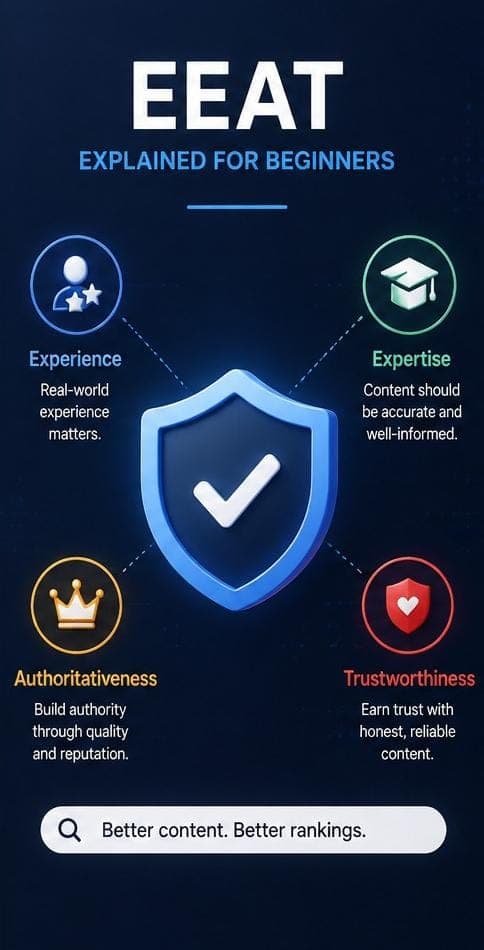
EEAT stands for Experience, Expertise, Authoritativeness, and Trustworthiness. Google uses these quality signals to evaluate whether content is reliable and valuable for users. While EEAT is not a direct ranking factor, it strongly influences how Google assesses content quality.EEAT Explained
2. Why is EEAT important for Google rankings?
EEAT helps Google determine whether your content deserves to rank. Websites that demonstrate real experience, expert knowledge, strong authority, and trustworthiness are more likely to perform well in search results.EEAT Explained
3. How can I improve my website’s EEAT?
You can improve EEAT by:
- Publishing accurate and original content.
- Showcasing author credentials.
- Citing trustworthy sources.
- Collecting genuine customer reviews.
- Keeping content updated.
- Securing your website with HTTPS.
- Building authoritative backlinks.
- EEAT Explained
4. Does EEAT apply to every website?
Yes. Although EEAT is especially important for health, finance, and legal websites, every website benefits from demonstrating expertise, authority, and trust. Strong EEAT signals can improve credibility across all industries.
5. Is EEAT a direct Google ranking factor?
No. Google has stated that EEAT is part of its Search Quality Evaluator Guidelines rather than a direct ranking signal. However, content that aligns with EEAT principles often performs better because it meets Google’s quality expectations.EEAT Explained
Key Takeaways
- EEAT helps Google evaluate the quality and credibility of content.
- Trust is the foundation of every successful SEO strategy.
- Demonstrate real-world experience whenever possible.
- Highlight author expertise and qualifications.
- Build authority through high-quality backlinks and brand mentions.
- Maintain accurate, updated, and user-focused content.
- Prioritize user experience alongside technical SEO.
- Consistently applying EEAT principles leads to stronger long-term organic growth.
- EEAT Explained
Call to Action
Ready to improve your search rankings? Start applying EEAT principles to every page of your website. Focus on creating helpful, trustworthy, and experience-driven content that genuinely serves your audience. As your credibility grows, so will your visibility in Google Search, bringing more qualified traffic and long-term SEO success.
Common EEAT Mistakes That Can Hurt Your Rankings
Even websites with excellent content can struggle to rank if they overlook the principles of EEAT. Google values content that is reliable, user-focused, and backed by genuine expertise. Avoiding these common mistakes can help strengthen your site’s credibility and improve its search performance.
1. Publishing Thin or Generic Content
Content that offers little value, repeats information found elsewhere, or lacks original insights is unlikely to earn Google’s trust. Every article should answer user questions thoroughly and provide unique perspectives or practical advice.EEAT Explained
Instead:
- Share real examples and case studies.
- Include actionable tips.
- Update outdated information regularly.
- Write with your audience’s search intent in mind.
2. Hiding Author Information
Anonymous content can reduce trust, especially in industries where expertise matters. Readers and search engines want to know who created the content.
Best Practices:
- Add an author bio.
- Include qualifications and experience.
- Link to professional profiles when appropriate.
- Display contact information for your business.
- EEAT Explained
3. Ignoring Content Updates
SEO is not a one-time task. Search engines prefer fresh, accurate, and relevant information. An article written years ago may contain outdated statistics or obsolete recommendations.
Create a content audit schedule to:
- Refresh statistics.
- Replace broken links.
- Add new sections.
- Improve readability.
- Optimize for new search intent.
- EEAT Explained
4. Making Unsupported Claims
Publishing exaggerated claims without evidence can reduce trust. If you mention statistics, studies, or industry facts, always reference reputable sources.
Examples include:
- Government websites
- Academic research
- Industry reports
- Official company publications
- EEAT Explained
Reliable references demonstrate authority and improve the credibility of your content.
5. Neglecting Website Security
A secure website contributes to user trust. Visitors are less likely to engage with a site that appears unsafe or lacks basic security measures.
Essential security practices include:
- HTTPS encryption
- Strong passwords
- Regular software updates
- Malware protection
- Daily backups
- EEAT Explained
Security not only protects your visitors but also supports a trustworthy online presence.
EEAT Checklist for Website Owners
Use this checklist before publishing any new content.EEAT Explained
✔ Content written by knowledgeable authors
✔ Real experience included where appropriate
✔ Clear author biography
✔ Updated information
✔ Original insights
✔ Credible external references
✔ Internal links to related articles
✔ Mobile-friendly design
✔ Fast page loading speed
✔ Secure HTTPS website
✔ Easy-to-read formatting
✔ Grammar and spelling checked
✔ Accurate page title and meta description
✔ Helpful images with optimized alt text
✔ Clear call-to-action
Following this checklist consistently helps establish authority and builds long-term trust with both users and search engines.EEAT Explained
Final Thoughts
Google’s algorithms continue to evolve, but one principle remains constant: websites that provide trustworthy, expert, and user-focused content are more likely to achieve lasting success. EEAT is not about finding shortcuts to rankings—it’s about building a reputation that users can rely on.
By investing in quality content, showcasing genuine expertise, maintaining transparency, and continually improving your website, you create a stronger foundation for sustainable SEO growth. Over time, these efforts can lead to increased visibility, higher organic traffic, stronger brand authority, and greater user loyalty.
When trust becomes the core of your SEO strategy, higher rankings often follow naturally.
Related Topics for Internal Linking
- What Is Google Helpful Content?
- How to Improve Website Authority
- SEO Content Writing Best Practices
- How to Build High-Quality Backlinks
- On-Page SEO Checklist
- Technical SEO for Beginners
- Core Web Vitals Explained
- How to Increase Organic Traffic
- Top Google Ranking Factors
- Content Marketing Strategies That Work
SEO Categories
- SEO
- Search Engine Optimization
- Content Marketing
- Digital Marketing
- Google SEO
- Website Optimization
Frequently Asked Questions (FAQs)
1. What does EEAT stand for in SEO?
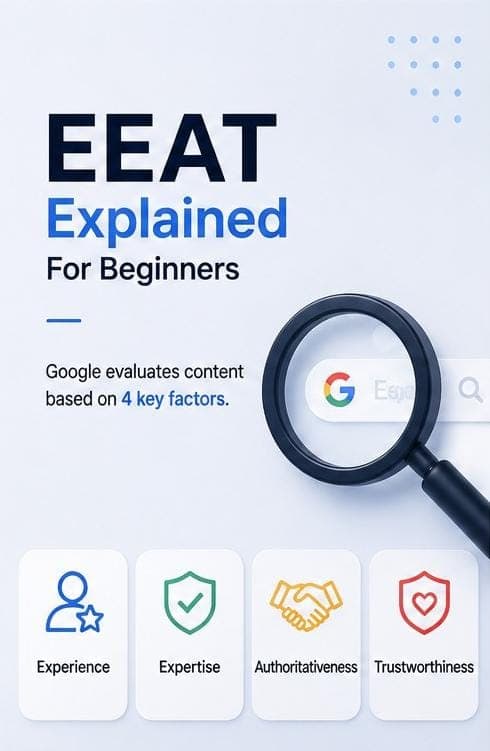
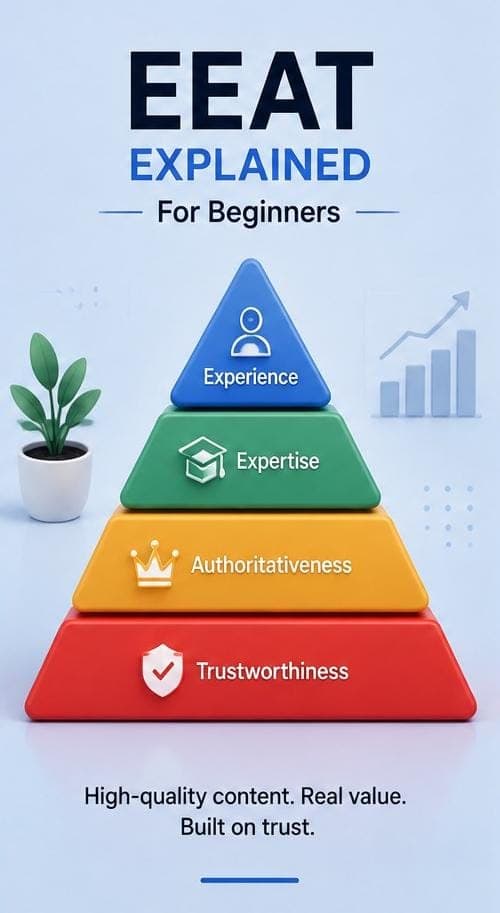
EEAT stands for Experience, Expertise, Authoritativeness, and Trustworthiness. Google uses these quality signals to evaluate whether content is reliable and valuable for users. While EEAT is not a direct ranking factor, it strongly influences how Google assesses content quality.
2. Why is EEAT important for Google rankings?
EEAT helps Google determine whether your content deserves to rank. Websites that demonstrate real experience, expert knowledge, strong authority, and trustworthiness are more likely to perform well in search results.
3. How can I improve my website’s EEAT?
You can improve EEAT by:
- Publishing accurate and original content.
- Showcasing author credentials.
- Citing trustworthy sources.
- Collecting genuine customer reviews.
- Keeping content updated.
- Securing your website with HTTPS.
- Building authoritative backlinks.
4. Does EEAT apply to every website?
Yes. Although EEAT is especially important for health, finance, and legal websites, every website benefits from demonstrating expertise, authority, and trust. Strong EEAT signals can improve credibility across all industries.
5. Is EEAT a direct Google ranking factor?
No. Google has stated that EEAT is part of its Search Quality Evaluator Guidelines rather than a direct ranking signal. However, content that aligns with EEAT principles often performs better because it meets Google’s quality expectations.
Key Takeaways
- EEAT helps Google evaluate the quality and credibility of content.
- Trust is the foundation of every successful SEO strategy.
- Demonstrate real-world experience whenever possible.
- Highlight author expertise and qualifications.
- Build authority through high-quality backlinks and brand mentions.
- Maintain accurate, updated, and user-focused content.
- Prioritize user experience alongside technical SEO.
- Consistently applying EEAT principles leads to stronger long-term organic growth.
Call to Action
Ready to improve your search rankings? Start applying EEAT principles to every page of your website. Focus on creating helpful, trustworthy, and experience-driven content that genuinely serves your audience. As your credibility grows, so will your visibility in Google Search, bringing more qualified traffic and long-term SEO success.
Common EEAT Mistakes That Can Hurt Your Rankings
Even websites with excellent content can struggle to rank if they overlook the principles of EEAT. Google values content that is reliable, user-focused, and backed by genuine expertise. Avoiding these common mistakes can help strengthen your site’s credibility and improve its search performance.
1. Publishing Thin or Generic Content
Content that offers little value, repeats information found elsewhere, or lacks original insights is unlikely to earn Google’s trust. Every article should answer user questions thoroughly and provide unique perspectives or practical advice.
Instead:
- Share real examples and case studies.
- Include actionable tips.
- Update outdated information regularly.
- Write with your audience’s search intent in mind.
2. Hiding Author Information
Anonymous content can reduce trust, especially in industries where expertise matters. Readers and search engines want to know who created the content.
Best Practices:
- Add an author bio.
- Include qualifications and experience.
- Link to professional profiles when appropriate.
- Display contact information for your business.
3. Ignoring Content Updates
SEO is not a one-time task. Search engines prefer fresh, accurate, and relevant information. An article written years ago may contain outdated statistics or obsolete recommendations.
Create a content audit schedule to:
- Refresh statistics.
- Replace broken links.
- Add new sections.
- Improve readability.
- Optimize for new search intent.
4. Making Unsupported Claims
Publishing exaggerated claims without evidence can reduce trust. If you mention statistics, studies, or industry facts, always reference reputable sources.
Examples include:
- Government websites
- Academic research
- Industry reports
- Official company publications
Reliable references demonstrate authority and improve the credibility of your content.
5. Neglecting Website Security
A secure website contributes to user trust. Visitors are less likely to engage with a site that appears unsafe or lacks basic security measures.
Essential security practices include:
- HTTPS encryption
- Strong passwords
- Regular software updates
- Malware protection
- Daily backups
Security not only protects your visitors but also supports a trustworthy online presence.
EEAT Checklist for Website Owners
Use this checklist before publishing any new content.
✔ Content written by knowledgeable authors
✔ Real experience included where appropriate
✔ Clear author biography
✔ Updated information
✔ Original insights
✔ Credible external references
✔ Internal links to related articles
✔ Mobile-friendly design
✔ Fast page loading speed
✔ Secure HTTPS website
✔ Easy-to-read formatting
✔ Grammar and spelling checked
✔ Accurate page title and meta description
✔ Helpful images with optimized alt text
✔ Clear call-to-action
Following this checklist consistently helps establish authority and builds long-term trust with both users and search engines.
Final Thoughts
Google’s algorithms continue to evolve, but one principle remains constant: websites that provide trustworthy, expert, and user-focused content are more likely to achieve lasting success. EEAT is not about finding shortcuts to rankings—it’s about building a reputation that users can rely on.
By investing in quality content, showcasing genuine expertise, maintaining transparency, and continually improving your website, you create a stronger foundation for sustainable SEO growth. Over time, these efforts can lead to increased visibility, higher organic traffic, stronger brand authority, and greater user loyalty.
When trust becomes the core of your SEO strategy, higher rankings often follow naturally.
Created with AIPRM Prompt “Yoast Pro 100% Article Ranking Expert ️”
Focus Keyphrases (3)
- EEAT Explained
- How to Build Trust and Rank Higher
- Google EEAT Guidelines
SEO Titles (3) (Under 50 Characters)
- EEAT Explained: Rank Higher with Trust
- Google EEAT: Build Trust & SEO
- EEAT Explained for Better Rankings
Attractive Slugs (3)
- eeat-explained
- build-trust-rank-higher
- google-eeat-guide
Meta Descriptions (3) (Under 155 Characters)
- Learn EEAT explained and discover how trust, expertise, authority, and experience can improve your Google rankings and SEO success.
- EEAT explained in simple terms. Build credibility, increase trust, and rank higher with proven SEO best practices.
- Master Google EEAT guidelines to strengthen your website’s authority, earn trust, and achieve better organic search rankings.
Tags (5)
#EEAT #SEO #GoogleRanking #ContentMarketing #DigitalMarketing
Social Media Hooks (3)
- 🚀 Why do some websites dominate Google while others disappear? Discover how EEAT can transform your rankings.
- 💡 Google doesn’t just rank content—it ranks trust. Learn the EEAT strategy every website owner should know.
- 📈 Ready to build authority and earn higher rankings? Explore the complete guide to Google’s EEAT principles today.
Keyphrase Synonyms (5)
EEAT guide, Google EEAT, SEO trust signals, website authority, search ranking factors
Created with AIPRM Prompt “Yoast Pro 100% Article Ranking Expert ️”
Focus Keyphrases (3)
- EEAT Explained
- How to Build Trust and Rank Higher
- Google EEAT Guidelines
SEO Titles (3) (Under 50 Characters)
- EEAT Explained: Rank Higher with Trust
- Google EEAT: Build Trust & SEO
- EEAT Explained for Better Rankings
Attractive Slugs (3)
- eeat-explained
- build-trust-rank-higher
- google-eeat-guide
Meta Descriptions (3) (Under 155 Characters)
- Learn EEAT explained and discover how trust, expertise, authority, and experience can improve your Google rankings and SEO success.
- EEAT explained in simple terms. Build credibility, increase trust, and rank higher with proven SEO best practices.
- Master Google EEAT guidelines to strengthen your website’s authority, earn trust, and achieve better organic search rankings.
Tags (5)
#EEAT #SEO #GoogleRanking #ContentMarketing #DigitalMarketing
Social Media Hooks (3)
- 🚀 Why do some websites dominate Google while others disappear? Discover how EEAT can transform your rankings.
- 💡 Google doesn’t just rank content—it ranks trust. Learn the EEAT strategy every website owner should know.
- 📈 Ready to build authority and earn higher rankings? Explore the complete guide to Google’s EEAT principles today.
Keyphrase Synonyms (5)
EEAT guide, Google EEAT, SEO trust signals, website authority, search ranking factorsCreated with AIPRM Prompt “Yoast Pro 100% Article Ranking Expert ️”
Focus Keyphrases (3)
- EEAT Explained
- How to Build Trust and Rank Higher
- Google EEAT Guidelines
SEO Titles (3) (Under 50 Characters)
- EEAT Explained: Rank Higher with Trust
- Google EEAT: Build Trust & SEO
- EEAT Explained for Better Rankings
Attractive Slugs (3)
- eeat-explained
- build-trust-rank-higher
- google-eeat-guide
Meta Descriptions (3) (Under 155 Characters)
- Learn EEAT explained and discover how trust, expertise, authority, and experience can improve your Google rankings and SEO success.
- EEAT explained in simple terms. Build credibility, increase trust, and rank higher with proven SEO best practices.
- Master Google EEAT guidelines to strengthen your website’s authority, earn trust, and achieve better organic search rankings.
Tags (5)
#EEAT #SEO #GoogleRanking #ContentMarketing #DigitalMarketing
Social Media Hooks (3)
- 🚀 Why do some websites dominate Google while others disappear? Discover how EEAT can transform your rankings.
- 💡 Google doesn’t just rank content—it ranks trust. Learn the EEAT strategy every website owner should know.
- 📈 Ready to build authority and earn higher rankings? Explore the complete guide to Google’s EEAT principles today.
Keyphrase Synonyms (5)
EEAT guide, Google EEAT, SEO trust signals, website authority, search ranking factors
Related Topics for Internal Linking
- What Is Google Helpful Content?
- How to Improve Website Authority
- SEO Content Writing Best Practices
- How to Build High-Quality Backlinks
- On-Page SEO Checklist
- Technical SEO for Beginners
- Core Web Vitals Explained
- How to Increase Organic Traffic
- Top Google Ranking Factors
- Content Marketing Strategies That Work
SEO Categories
- SEO
- Search Engine Optimization
- Content Marketing
- Digital Marketing
- Google SEO
- Website Optimization
Frequently Asked Questions (FAQs)
1. What does EEAT stand for in SEO?
EEAT stands for Experience, Expertise, Authoritativeness, and Trustworthiness. Google uses these quality signals to evaluate whether content is reliable and valuable for users. While EEAT is not a direct ranking factor, it strongly influences how Google assesses content quality.
2. Why is EEAT important for Google rankings?
EEAT helps Google determine whether your content deserves to rank. Websites that demonstrate real experience, expert knowledge, strong authority, and trustworthiness are more likely to perform well in search results.
3. How can I improve my website’s EEAT?
You can improve EEAT by:
- Publishing accurate and original content.
- Showcasing author credentials.
- Citing trustworthy sources.
- Collecting genuine customer reviews.
- Keeping content updated.
- Securing your website with HTTPS.
- Building authoritative backlinks.
4. Does EEAT apply to every website?
Yes. Although EEAT is especially important for health, finance, and legal websites, every website benefits from demonstrating expertise, authority, and trust. Strong EEAT signals can improve credibility across all industries.
5. Is EEAT a direct Google ranking factor?
No. Google has stated that EEAT is part of its Search Quality Evaluator Guidelines rather than a direct ranking signal. However, content that aligns with EEAT principles often performs better because it meets Google’s quality expectations.